Building a Business Without Losing Yourself: The Founder’s Balancing Act
What this conversation covers
Some years a founder's job is simply to hold on. For Kris Mochrie, the past year has been one of the toughest of his life.
Kris is founder and managing director of Hotal, a UK company that connects corporate event buyers with venues and suppliers, and he has spent more than a decade in hospitality after starting out in FMCG. He talks with Laurent about running a business in an industry where rising costs have flipped the old margins, about the fear of being seen as a failure, and about what success should mean when other people's salaries depend on you.
They also get practical: why chasing four audiences at once meant nothing was done well, how he asked his team to shape the strategy instead of handing them another deck, and how coaching helped him see where the business still runs through him.
A candid conversation for founders carrying more than their team can see.
Key takeaways from this episode
- Use AI in the back office, keep people up front. AI made Hotal's small development team faster and cut admin, but in hospitality the experience still has to come from people. 11:07
- Define success yourself. Fear of being seen as a failure drove Kris for years, and it also made his idea of success unreal. 15:11
- Clarity beats spinning plates. Chasing four audiences and several products at once meant nothing was done well, so the plan for 2027 has three priorities. 21:49
- Ask the team before you write the strategy deck. Kris asked his team what the business is, what to stop and what to do more of, and the strategy got clearer. 27:45
- The founder bottleneck is a stage, not a flaw. Every decision running through the founder is normal early on; the next stage is a business that serves customers without you. 35:33
- Letting go is hardest where you are good. Handing over admin is easy; handing over sales, where you know you can deliver, is the real test. 43:10
Meet the guest
Who joined Laurent for this conversation.
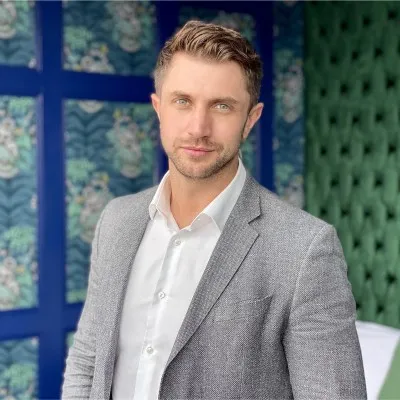
Kris Mochrie is founder and managing director of Hotal, a UK company that connects corporate event buyers with venues and suppliers. He started his career in FMCG with brands such as Red Bull and Disney. On Founders on the Edge he talks about resilience, clarity and letting go.
Read the full conversation
This transcript was generated with AI and lightly edited, so it may contain errors. Timestamps follow the published audio.
Kris Mochrie · 00:00
AI has been brilliant. I think there are two things. I think AI is really good for coding, for helping us. So one of the reasons why we can shrink down is because our development team is a lot smaller. I would say they're building faster and better than ever before. My belief in hospitality is that you've got to be very careful with using AI, because hospitality is humans. That's where hospitality was born. It's about connecting with a person. It's about giving them an experience. And I don't think you can give anyone the best experience with a robot or a chatbot.
That's what I think is going to be the driving force of why you do it. But I think getting out of the mindset of caring what other people think is freedom in itself. And I definitely was, and I'm probably still a bit. Even though I can openly talk about it now, there's probably still a part of me which cares what people think and doesn't want to be a failure.
It's been such a roller coaster. We've had some real peaks and then we've had some real lows. But you've always got to hold on to the fact that those low periods are where you get your high periods too. It's normally when you're in those depths of despair that you find the solution, or you find what you need to do to make sure the customers are happy, or to get the product closer to where it needs to be. But they can be really dark places sometimes.
Laurent Notin · 01:18
Welcome to Founders on the Edge. I'm Laurent Notin, executive coach and founder of InnerEdge. This show is about what happens as the business grows and the way its founder has to evolve with it.
Today I'm talking with Kris Mochrie, founder and managing director at Hotal, a UK-based company that offers sales, marketing and platform solutions for the leisure, hospitality and attraction industry. Hotal also represents a number of leading venues and hospitality groups on their sales solutions. As for Kris, he is a commercial hospitality leader and founder with over 12 years of experience building ambitious teams and exceptional customer experiences. He is deeply passionate about connecting great people across the travel, lifestyle and hospitality sectors. So let's get into it. Welcome, Kris! How are you?
Kris Mochrie · 02:12
I'm good, good. I've had my coffee, so yeah, ready to chat.
Laurent Notin · 02:17
Did I miss anything in your intro?
Kris Mochrie · 02:21
No, not at all, I think. Not really. Hospitality has been what I've been living and breathing for a good ten years now. Prior to that, I was in FMCG, so I worked for Red Bull and Disney and a few other brands, and then made the plunge into hospitality for some wild reason.
Laurent Notin · 02:46
Okay. Well, I'd like to know you a bit more. So tell us, what's your family status?
Kris Mochrie · 02:54
So I am married. I got married last August, which was cool, to a guy called Max Parker, who is great, and we've been together for six years. He's actually living in Canada at the moment, which has been quite tough, because obviously we've got the office in Manchester. He's over in Canada doing a job, which is cool, but it means going back and forward, that kind of stuff. But no, family are great. So there's just me and Max, and then we have our little dog, Roo, who is our daughter. Very, very family-centric. I'm very close to my sisters, and my mum is still based in Liverpool, which is cool. But yeah, that's us.
Laurent Notin · 03:45
How do they like the fact that you are a founder?
Kris Mochrie · 03:48
Wow. I mean, at the moment, they hate it. I think they've always known that I'm someone who likes to find solutions. In my view, if you're someone who likes to fix things, then you're probably going to be someone who should be an entrepreneur. Ever since I was a child, I'd always try and fix a problem, find a solution, find an answer. Even if the answer was no, I'd always say to my mum, well, I could do this too. I'd always present different arguments. And I think if that's innate in you, then you should definitely look into being an entrepreneur.
Although, going back to your question, I don't think every family member understands what it takes, or understands how it can change you, for the good and for the bad. And I think when you're going through the bad times, all families want to do is protect you. So they're just like: this is not for you, do something else. We don't want to see you like this. We miss having your time. So at the moment, I don't think the family are too keen on what I currently do, if I'm being honest.
Laurent Notin · 05:08
Why are you saying "at the moment"?
Kris Mochrie · 05:11
It's just a really tough time at the moment. We've been in business now for... I can give you the whole journey, but it's been such a roller coaster. We've had some real peaks and then we've had some real lows, and we're going through that low period at the moment. But you've always got to hold on to the fact that those low periods are where you get your high periods too. It's normally when you're in those depths of despair that you find the solution, or you find what you need to do to make sure the customers are happy, or to get the product closer to where it needs to be.
But they can be really dark places sometimes, and not nice places. And it's in those places where a lot of people would just jump off the roller coaster, or jump ship, before it goes back up, because they just can't cope. And there have been times where I'm like, let me out, let me get off this train, more than once. Just clinging on like that, holding on.
Laurent Notin · 06:10
Right, but you're still here? Are you mad? Are you addicted?
Kris Mochrie · 06:19
Do you know what I say a lot? I do think you've got to have a little bit of crazy, loco, delusional optimism to be a founder. You have to, because if you're too pragmatic and too real, you will never survive the journey that it's going to take you on. And I'm saying this as someone who is failing at the moment. I don't see myself as a success. Other people might define success as, well, you've still got your own business. But I see success as when everything is moving upwards, when customers are happy, when staff are happy, when the product has real product-market fit. And at the moment I haven't got all those things. So for me, we're not there yet. And when you put so much work into it over years, that can be quite gut-wrenching too.
Laurent Notin · 07:19
Hmm. The show is called Founders on the Edge. Would you say you are a founder on the edge?
Kris Mochrie · 07:27
I'm off the edge. I'm literally like this, holding on. I am holding on. I'm holding on by the skin of my arm.
No, it's been a really tough time. I think it's global, but especially in the UK, hospitality is ridiculously tough. If you think about it, when I was working hotel side, maybe six, seven years ago, just on food and beverage, you'd work on a GP of around 70 to 30. So 30% cost, 70% profit. That has completely flipped in six years, because the cost of food has gone so high, and the cost of labour, in the UK especially, has gone ridiculously high. And without getting political, I do think the government needs to do something to support these venues. When we're bringing a product out, some venues are just trying to keep their lights on, or just trying to have broadband or wifi. We are down the list when it comes to what they need sometimes. So I just think it's a really tough time to have a business in hospitality.
That being said, because I'm the delusional optimist that I am, it's also a great time to be in events. In this world of AI that we're currently in, the human connection is more important than ever. Being able to be in a room. All these tech companies, all the law firms and the large corporates can see now that relationships matter, human connection matters, sales happen in the room. Sales come from trust. So what we need to do is look at our model and make sure that we're moving towards supporting events as much as possible, rather than just bringing venues on board. We're working on how we flip that model currently.
Laurent Notin · 09:29
Right. What's the size of your business, roughly, at the moment?
Kris Mochrie · 09:35
In people, or turnover, or...?
Laurent Notin · 09:36
Whatever you want to share.
Kris Mochrie · 09:39
Well, it's changed. The good thing is we've not changed in terms of revenue. We do just over a million pounds a year, so it's not huge. But we started off on 237k in year one, then we went to 698, and then we're over a million now, in year three. We also significantly increased our people, which we probably didn't need to do, with all respect to the people that have worked for us and have come and gone.
We had this model where we thought we could go into each city. I called it "own the city". It was something that I learned at Red Bull, where you would flood distribution into a city. And we tried that, and it didn't work for a few reasons. One, some people weren't great. They falsified stuff, or they just weren't real salespeople. Amazing at the interview, and then you put them into the field: terrible. And you train them and train them and train them. We gave them, I would say, some of the best training handbooks, went out with them for days in the field, gave them time to breathe and learn, but they just didn't get it. So that was one thing. And secondly, obviously, the way that hospitality was changing quite significantly. We were once at 27 people; we're now down to about 12. And weirdly, revenue hasn't changed.
Laurent Notin · 11:06
Yeah. And I was about to ask you: what's the impact of AI on your business?
Kris Mochrie · 11:12
AI has been brilliant. I think there are two things. I think AI is really good for coding, for helping us. So one of the reasons why we can shrink down is because our development team is a lot smaller. We have three in our development team now. We still have a little bit of outsourced support as well, but only three in our development team, which is great. I would say they're building faster and better than ever before. So that's the benefit of AI.
My belief in hospitality is that you've got to be very careful with using AI, because hospitality is humans. That's where hospitality was born. It's about connecting with a person. It's about giving them an experience. And I don't think you can give anyone the best experience with a robot or a chatbot. In the back office, you can make it very efficient, so the admin time that we've cut down on is great. But hospitality is all about relationships, so if we can blend the two, then brilliant. And that's what we're trying to do with our new solution.
Laurent Notin · 12:14
Amazing. Well, coming back to you: if you could have dinner, or lunch, or a beer with any entrepreneur or thought leader, who would it be?
Kris Mochrie · 12:29
Oh my gosh, do you know what? I'm going to be really cheesy. Actually, it's not cheesy, because I think when you're going through a tough time in life, whether it's business, whether it's personal, it's funny, because your phone knows. You're probably searching for validation, or for things that make you feel motivated. Am I doing the right thing? What should I do here? So your phone knows what you're thinking, and you get the algorithm of people.
So I've been getting into Oprah Winfrey, and she's brilliant, because she breaks everything down, and some of the stuff she comes out with is great. So I get Oprah a lot. There's a guy called Peter Crone, who I think is called the mind architect. He's phenomenal. I just think he's great. When you're feeling like this, you need those little quotes, you need to find out from people who've done it before. I obviously love a bit of Gary V as well, and his quotes on keep going, don't give up, and stop putting all this pressure on yourself to be a success at a certain age. What does success look like to you? And I also like, I always get her name wrong, Brené Brown, is it? I think so. I'd better be corrected. But the balance of those three is really important. I think it's really important to listen to podcasts, or get inspiration from people who've walked the walk before.
There are some great podcasts out there and great people being interviewed. I was watching a few clips of the guy that did WeWork, and he was saying he lost everything and started back up again. When you're going through such a tough time... I would say I'm someone who would jump out of bed. I am super positive. And yet for probably the past nine months, I've not really struggled to get out of bed, but I've been feeling not positive at all, and anxious. And that's purely because when you've got an entrepreneurial brain, when you have your own business, you're constantly trying to think of the solution. You're trying to think of every single path it could go down, because in a way you want to control the path to success. You want to control the path to make sure your customers are happy. So yeah, I think having people that you aspire to have dinner with, or look up to, or whose quotes you use, is really important.
Laurent Notin · 15:11
So what are the stories that you tell yourself in your mind?
Kris Mochrie · 15:16
Gosh. I had a big problem with being a failure, something that I've had for a long time. I think it stems from years ago. Something happened in my earlier life when I didn't really know who I was as a person. And because I didn't know who I was, I was trying to be someone that I wasn't as well, which I don't think is healthy at all. And then when things happen to you, whether it be in childhood or, for me, in my early twenties too, things that aren't great, you constantly try and prove to people: I am a good person, I am a good person and I can be successful. You don't want to be labelled as a failure. It's a great fuel, but it has two sides. It can be a great fuel, but it can also be not great at all, because your definition of success becomes something that isn't actually real.
And it's taken me going through this really tough time over the past nine months to realise that. I always had on my phone: why do we do this? As entrepreneurs, why do we work this hard? What is the end goal? For some people it's: I just want to make a success of it. For some people it's because the problem they're solving is to help humanity, or it's a real vocation. For some people it's because they really want to provide for their family. They really want to be able to be the breadwinner. And Peter Crone, the mind architect, was saying that what everybody wants is just to be free, whether that's financial freedom or freedom within yourself.
And I think for me, this definition of success was always because I just wanted other people to think I was successful. What is it for me? I did always have the family thing, though. I always wanted to make sure that my mum was okay. I grew up in a single-parent family, so she's very important to me, and making sure that she has a great retired life. I don't want to say OAP, but a great retired life. And then my sisters and the rest of the family, and their kids, and my own family. You want to make sure that they've got that freedom. I think that's going to be a driving force of why you do it. But I think getting out of the mindset of caring what other people think is freedom in itself. And I definitely was, and I'm probably still a bit. Even though I can openly talk about it now, there's probably still a part of me which cares what people think and doesn't want to be a failure.
Laurent Notin · 18:31
What does being a failure look like?
Kris Mochrie · 18:37
I don't know. It's funny, because I think losing it all is not getting to the end goal. For me it's starting something and not finishing it, having these dreams and ambitions and not getting there. And I think even for your own family, it's not being able to put food on the table, not being able to pay the bills, and stuff like that. It can be as literal as that. As an entrepreneur, you're a risk taker, which is great. You've got to be a high risk taker, and sometimes things don't work out.
And I think having those small failures within a business is actually really good, because it's where you learn. You've got to have those mistakes to learn. So I think it's really important to have those small failures. But that kind of anxiety of the big failure: what if the whole company goes? What if it doesn't succeed, then what's next? I think that, for me, feels like a failure.
It's a weird one, because sometimes, and this is obviously from speaking to people and reading books and quotes from people who've gone through it, if you do fail, the amount that you get from that is tenfold. Someone else said that, actually: failing and failing and failing again is actually learning and learning, and actually becoming successful. It's that journey to it. But when you're in it, and you've got people's salaries to pay, people that you're friends with on Instagram and you can see their kids, I think it's really tough. And I don't know if emotionally I've been strong enough as a business leader, because I find it so hard not to think about that when payroll is coming in, or when people haven't paid their invoices, or we're chasing cash all the time. I think that's really difficult.
Laurent Notin · 20:52
Yeah. But Kris, let me tell you, you're not the only one.
Kris Mochrie · 20:57
I know I'm not. I just think sometimes, and you know what, this is it again, stay in your own lane and focus on yourself, but I do see some of the larger companies that have raised significant amounts of money to make sure they've got so much fuel for their journey. And now I understand why. Because at first I was like, you don't need that much money. Surely you don't. Bootstrap yourself, take a little bit and just become profitable. But when you're being positive, you're not ready for those bumps in the road that are going to come. So you do need to have that fortress, that moat, to protect you. And that's something you learn when you're in the thick of it, definitely.
Laurent Notin · 21:42
Yeah, you learn to build resilience, I guess.
Kris Mochrie · 21:45
Oh my word.
Laurent Notin · 21:49
What's the dream for your business?
Kris Mochrie · 21:52
Gosh.
Laurent Notin · 21:54
You're the one talking about dreams and goals.
Kris Mochrie · 21:58
I think, do you know what? I think it's really difficult, because I was so clear at the start, and I'm still very clear on who our customer is and the problem that we're solving. I think the dream for us, and this is the honest truth at the present time, is just to become so clear that we remove the chaos. I think the problem at the start was that we were trying to do so many things and trying to solve so many problems. They were all the same problem, but there were so many plates spinning. We were trying to go after four different audiences. We were trying to build multiple things within our tech stack so that we could find one solution for our customer. And what that does is you don't do anything great. If someone had told me that at the start, I would have been like, no, not at all, we're going for it, I've got the right team.
But genuinely, for us, for 2027, we've said we're actually going back to basics. As a team, we're going back to basics to make sure that we deliver for the customers that we've got, and that what we're building is absolutely right for them, before we start launching smaller variations. I think it's really important to get customers involved early on, so that they give feedback on the model and on what they need. But for us, it's just making sure that Hotal solves a problem that is needed. And next year we just become clear. For me, that's becoming small again and building up slowly. We've got some incredible clients that we've worked really hard to get. And I think at one point we were probably going so fast that we could have lost clients, because we were scaling too quickly. Whereas now, look at the revenue too, by having a smaller team, by really laser-focusing on just three things, which we've defined recently, I think next year could be a really exciting year for us.
Laurent Notin · 24:04
Can you share those three things?
Kris Mochrie · 24:06
Yeah. We have a marketplace. We have supply on one side, which is our venues and our suppliers, and then we have our demand, which is our corporate customers. And in the middle we have this tech stack, which hopefully helps the corporate customers find the best supply and then contract. Our issue was that a lot of people that we did business for just didn't pay us. They took ten months to pay us commissions. So that was one issue. I think they also wanted more from the tech stack, from the supply side.
So for us, we know that demand is absolutely key. Our number one thing out of the three is demand. Demand is our North Star: making sure that we bring on the right events, the right companies that have the right briefs. So we've really focused on those companies. We have some great contacts with some of the biggest companies in the UK, and we're starting to do all their events now. So demand is our number one.
The second piece, going back to what I said about those commissions, is owning the payment layer. We're bringing out a payment solution, which means that we can not only find you the venue and the supplier for your event, but we can also pay them on your behalf. Companies hate having multiple suppliers that take ages to set up on payroll, so they can use Hotal as their one-stop shop for all their event needs, which is great. That's going to be our biggest piece. We've nearly finished testing it, and we will start releasing it before Christmas with some of our customers. It also means that their events are fully insured. We've had it recently where, unfortunately, some hospitality venues have gone under, and corporate clients, not through us but through other people, have actually lost their deposits and their money. So when they do it through our payment solution, it'll be fully protected and insured by a third party, which is great.
So they're the two things. The third one is really honing in on more of those big corporates. We've got a big pitch with Netflix coming up soon, fingers crossed. We've got pitches with a number of other large corporates in that realm too. And for us, we've said that if we can get 20 brilliant clients that do over 150 events a year, we really account-manage those, and all the smaller ones should be able to automate through the platform quite easily. So that's our plan. We'll see how it goes.
Laurent Notin · 26:53
Well, it looks very clear. You were looking for clarity, but it sounded very clear. It sounded like you know what you need to do.
Kris Mochrie · 27:02
Yeah, it is. The great thing about what we're doing at the moment is that I'm trying to bring the senior team on board. Sometimes as a startup you want to move so quick, you want to pivot so quick, because you need to. You can sometimes go so fast that you don't bring the team along with you. And I think that's something that I've definitely done. I'm the one that's up until sometimes one or two o'clock in the morning, trying to think: what is the best solution for this? How do we solve this problem for this customer? Actually, if we did it this way, would that be better? And because I've gone through that thought process, I've been so impatient to bring the team on that journey, and just delivered another strategy deck.
So what I didn't want to do this time was just say: right, okay, we've had a tough time trading-wise over the summer, here's another strategy deck. Instead, I did a questionnaire for them all and said: right, what do you think the priorities are? What is our business in one line? Give me everything that you believe we should be focusing on. What does our customer want the most? What should we say no to? What should we be doing less of? What should we do more of? And I did this whole poll and questionnaire, and it was really interesting to get all the feedback coming in, because now we've just got our strategy really clear. We all know exactly who we are, what we are, what we want to do next year. And I think that was probably a good thing to do.
Laurent Notin · 28:24
This is an amazing lesson for all the founders who will listen to you: you involved your staff in deciding the strategy.
Kris Mochrie · 28:32
Yeah. I think it's important. I'm a solo founder, but everyone goes: the odds are stacked against you, and all this kind of stuff. And I'm like, I'm actually not a solo founder, because my team, the guys that have stuck with me through those real bottom curves, are the founders too. They have a small percentage in the business now, which is what they deserve, because they live and breathe it every single day. And I think it's very easy for people to jump ship, and they haven't, and I've been so blessed for that. That's another thing which makes you keep going, because at the end of the day, that's their pension. That's something that they want for their children. That's their legacy as well. So it's so important that we get it right. And going back to basics now, and getting really close to the team, I think is really important.
And we have lost people along the way. There are people who still gave up what they were offered and decided to jump ship. Some of them went to lesser roles, and some of them went to other places, because the life of a startup is not for everybody at all, and that's okay. That's fine. Some people want an easier life. Some people find freedom in working nine to five, having the breaks and having that balance, and that's absolutely fine too, because one day I'll definitely be there.
Laurent Notin · 29:57
Yeah. If you look back to when you started the journey with Hotal, and you look at yourself as the founder then and compare it to you as the founder today, what's different?
Kris Mochrie · 30:13
Gosh. I'm older. I've got more grey hair, definitely. Honestly, I've started getting grey in my beard and everything. Genuinely, it's from the past year, which has been one of the toughest of my life, I'd say. I've always been very naive, which is not a great thing. I've always been a little bit gullible. It's just who I am. I see the good in every single person, and it's something that I've always had. And as you navigate yourself through life and you get older, you realise not everyone's great, and not everyone's got the same good intentions as you. So that, I'd say, I've learned more than ever over the past three years, because you try and do your best for people, and they're not always going to return that favour. You see a lot of people as well, and they're probably in the wrong place in their life, who just falsify reports, or they just don't have any integrity at all.
I think integrity and being honest and transparent is absolutely key. And it's one thing that I've always tried to do with my team, to say: listen, just be honest. If you've done something wrong, it's not a problem, we'll learn from it and we'll move on. So I've learned that integrity is absolutely key, and not everybody has it at all.
But as a person, I don't want to lose that part of me, and hopefully I will get it back. But I'm definitely a lot more real than I was. When I started this journey, I was such a delusional optimist. I was going to be selling this business in 18 months. I was like, I'm going to get this, I'm going to be in every single city, I'm going to have 3,000 of this. My numbers were huge, and my team will tell you, I was getting them all motivated. I wanted to be in these countries, and I still do. But gosh, the energy. I'm tired, I'm so tired, and that's what business does to you. It can take the wind out of your sails. And I just think what's more important is having a great, solid business that can have longevity and can get there in the end, rather than going so quickly and falling over. So yeah, I'm definitely more tired than I was, but I'm a lot wiser than I was.
Laurent Notin · 32:58
Right. What's your favorite way to unwind? Gym?
Kris Mochrie · 33:03
Gym, going to the gym. I love the gym. I want to play more padel. The gym's really important for me. I think getting out, even just getting out and walking, is so important. Having a dog, and getting out early in the morning, is really key. But the gym for me is just my release time. It's really important. But yeah, I want to play more padel, be outdoors.
I write a lot as well. I like to write scripts. I think as someone who thinks a lot, if I didn't do that, I'd probably be thinking so much about the business that I'd be going around in circles. It's really important to know that I've got releases. So I love writing. Writing's really important to me.
Laurent Notin · 34:02
What do you write about?
Kris Mochrie · 34:04
I'm writing a script at the moment about a Victorian gang.
Laurent Notin · 34:12
That'd be the next Peaky Blinders.
Kris Mochrie · 34:15
Do you know what? I read this book about nine years ago that I absolutely loved, and I just thought this has to be a TV show one day. And it's just something that I love to do in my spare time.
A lot of entrepreneurs are creative. They've got the commercial strategy side, which is great, but you've got to be creative, because that's how you find solutions. You're constantly thinking. But I found myself at one point just focusing on work all the time. I had a pad, and every night I was just writing things down. What should I do with this? How should this structure work? Should I bring in this person for that role? Always looking at different things. And that's when you can become exhausted and burn out really quick. So I do an hour a day of writing, which I'm quite religious about, and it kind of switches me off. Other people read books. I'm not as much of a reader, because I tend to read a few pages and then forget what I've read, because my mind is going elsewhere. So I just tend to write instead, or I'll read short things.
Laurent Notin · 35:33
I want to talk a little bit about coaching, because you and I worked together a little. And please be honest. What can you say about coaching? What was the impact of coaching on you?
Kris Mochrie · 35:46
For me it was really good, and you know this. I think the one thing for me, and it's probably the same for a lot of founders out there, is that we started this business as me, then another person, and then another person. So you start as one person. We also bootstrapped our business. We made sure that every invoice that came in paid for our payroll, and we never became too big for our boots until the investors came in.
Because of that mentality, I would say nearly every single person that starts on that journey will become a bottleneck. Because that's all they know, every decision stops with them. Everything stops with them, because they're afraid of losing control, so that they don't lose the business. And I don't think there's anything wrong with that at all. I think it's a great place to be, because it gets you into that mentality. The next stage, or gear two of business, is to then move away from that bottleneck, which is what you were teaching me, which was brilliant: how do you walk away from the business and let it run successfully without you? Because that is the true measure of a business that's doing well. It means you've got solid foundations. It means you've got processes in place. It means that you are a business that knows its customer, that can serve its customer, and is solving the problem without you.
And I think that's something that has been really difficult for us, because when I've stepped away, it's been clear that those processes haven't been in place, because then I've had to get back involved in certain areas. And that can be a number of different things. It can be the team: not having the right staff and the right talent in the right positions. It can be clarity: not having the clarity or conviction about what you guys are actually doing. Are you all trying to spin too many plates? It can also just be giving them the trust to crack on and make mistakes, so they can learn from it and fix those problems.
I would say that I've done that, and I think it's probably been a really good exercise. And we've definitely lost customers from me stepping away, without a doubt, because sometimes people want you and they buy you. They don't always buy a solution. I've tried to hand it on to other people, and sometimes it just hasn't worked out. But some of them have made it work, which has been great.
But yeah, sorry, long answer to your question. For me, the bottleneck piece is really important, but I do think you ebb and flow with it. For example, we've gone back to basics now, so I'm probably back in the driving seat a bit more. And then eventually the idea is that we build it up. What I've said is that next year I want to make it really easy for everybody, so that everybody has full accountability, and no one's waiting for me for an answer or a decision. We're trying to work on that over the next three months, to make sure that 2027 is really streamlined in that sense.
Laurent Notin · 38:55
Right. So then it becomes about your ability to go down deep, understand the issues, and then come back up to fix them, or to look at the implications for the whole company.
Kris Mochrie · 39:11
I think so. I think so. I think the problem with small businesses like mine, and it is a small business, even though we've had investment, which has been great, is that we don't have the ability to have loads of senior people. We just don't. And that's the really tough one. I don't think other organisations really understand that. Not having a lot of senior people around is quite tough sometimes, for any business, I think. So that's where the bottleneck can creep in. You'll probably find that companies at the mid level or the small level have loads of bottlenecks, because they don't have the resources to bring on a team experienced enough to handle those things.
Laurent Notin · 40:08
Can you build them from inside?
Kris Mochrie · 40:12
Can you what, sorry?
Laurent Notin · 40:14
Can you build those people from inside?
Kris Mochrie · 40:17
I think so, yeah, and I've tried to. I've tried to do that as much as possible. But yeah, that's been hard.
Laurent Notin · 40:26
What's the hardest part of it?
Kris Mochrie · 40:30
I think the hardest thing is: they're not you. Do you know what? It makes me sound like... I don't want it to sound the way I'm thinking about it, but sometimes you just know that you can do the job better. And I think that's really difficult, because as an impatient person, I'd just rather do it myself. And I think that's part of being an entrepreneur and a founder: you're striving for perfection. So even a reply to an email, I maybe would have done slightly differently. Or closing a deal, I definitely would have done it differently. And that's what I find really hard. I get quite frustrated and impatient, because I know if I was on that call, I would have closed them this way. It's the patience you need as a trainer, to not be the bottleneck: well, you take them on it, how would you do it? I've got some calls this afternoon where I've got someone shadowing me, because I want them to just listen to how I do a sales call versus other people. You're never going to find people who will replace you. But what you can do is find people that are better in certain areas. Someone always said to me: bring people on board that are fantastic. That's going to be key.
Laurent Notin · 42:00
Imagine you find people who replace you. That would be like a series of Krises running the business.
Kris Mochrie · 42:10
Oh my gosh, yeah. No, do you know what? There are certain things that I'm not great at, and that's the key thing as well. I know my strengths. I know I can sell, I know I can strategize, I know I can get something across the line and finished. They're the things I know that I can do. But admin-wise, absolutely not. Give that to someone else. Diary, admin, that kind of stuff, not for me. Which is why we've got processes in place. Building tech is not one of my skill sets, but I tell you now, there are times when, especially with AI, I'd like to learn, because I just think it's something that I'd love to learn now. I've always been like: no, I'm a salesperson, I'm a sales and marketing person and an operations person. But actually, I think I'd love to learn to build.
Laurent Notin · 43:10
Yeah, I hear the same thing from many entrepreneurs. It's always very easy to delegate and let go of the things that you are not good at and that you don't like, like administration. But it's another issue when it comes to things where you think you're not too bad, or at least you were involved from the beginning, like sales and marketing. Among most founders I've been working with, it's the ability to let go. Letting go is a mindset.
Kris Mochrie · 43:51
Yeah. It is a mindset. And being able to let go... do you know what I do? I say this all the time about the bottleneck: I tell you now, for a fact, there's so much that goes on in our business that I don't know about, because it would be impossible to. And I think that's quite freeing. I honestly have got the best team. Gareth, Laura, Sammy, Paul, I've got a guy in Dubai called Cam who's absolutely smashing it at the moment. I'm so blessed to have them on board.
You need those people that keep you sane. For me, it's Sammy, who's my number two. I've known Sammy for ten years now. She was my PA when I was in employment as an MD in a hotel group, and then she followed me on this journey and she stayed with me. And she is so calm, even when I'm not. She's just got this great voice of reason. And she's now a bit like me. She's learned HR, she's learned payroll, she's learned finance, she's learned operations. She's become our chief of staff by being forced into all these different departments, because we don't have the revenue or the resource to have a head of each of those departments, like most big companies do. So you need those people to keep you sane. There's no way that I could do this journey on my own. A hundred percent not. So I'm so blessed and grateful that they've decided to stay with us through thick and thin.
Laurent Notin · 45:29
What would you do if you were not a founder?
Kris Mochrie · 45:34
I think I'd always be a founder in some respect. I'd always be creating something. I've not taken any money from this business for a year, because what's more important for me is making sure that the team are looked after and the business is growing. So I've got a side job as a consultant, which I've had to keep. A lot of people have said to me: you need to give that up, because you've got to focus on this. I've got one client that I've worked with for a long time, which has been absolutely brilliant, and I will stick with them, because I've made a huge impact on their organisation and they've made an impact on me. And they're in a similar market to ours, so it means that I can understand both angles. I think that's important.
But that's probably where I've found it the hardest: doing both, keeping both alive. It's been so hard. And people don't see that at all. People see me as smiley Kris, who comes in quite positive. But behind it there have been some really dark days and some really tough moments. There have been friends that I've not spoken to for a while, that I've missed out on. You sacrifice so many things. Sometimes you just want to have a quiet room, not speak to anybody, and let your head rest for a bit, because there's a lot of information going on.
But at the same time, I just think it's the way that I'm wired. Someone said to me once, and you probably see this on this podcast with how fast I speak, my brain works faster than I can speak sometimes. It's just the way I am. I've always been that way inclined. But if I wasn't doing this, I would probably be writing full time, creating stuff. Always creating, yeah.
Laurent Notin · 47:50
You're so creative. You mentioned something interesting that not a lot of people talk about: the cost of being an entrepreneur. You said you have not taken any money out of the business for a year, which is another reason why you keep the consulting on the side, because you need to make a living yourself. You need to earn some money. That is one thing that people don't see. We always romanticize entrepreneurship. We always look at the successes, but we tend to forget that success was not built overnight, and that many successful entrepreneurs failed on the way.
Kris Mochrie · 48:50
Yeah. And do you know what? Lots of people say to me all the time, I'm going to start this business, and I'm like: if you can, bootstrap yourself. And bootstrapping yourself can also mean keeping the job that you've got and doing it as a sideline. There are a few people that I know now who are leaving work, and I'm like: but you haven't proven the model. You haven't got revenue coming in yet. For me, you can be super intelligent and measured about it. Take a risk, by all means. But the way that you measure your risk shouldn't be just in your head. You've got to go and speak to customers. Go and find your first customer, get your first two, three, four customers, and then leave.
And that's what I've always done: even though I do take risks, they are quite measured. I still have bills to pay. I still have a mum that I need to provide for. So I can't and I won't be so frivolous and silly that I just go into it without anything at all. I'm from a working-class family. I don't have wealthy parents to fall back on. I don't have a trust fund. I don't have any of the things that some people have. I have zero. So that's where it can take its toll, especially when you're keeping a job as well as running a business. But if it's the right thing to do, it'll all work out well in the end. And that's the key thing.
Laurent Notin · 50:25
So you see, you're all positive!
Kris Mochrie · 50:26
I know. But do you know what? I'm the best at giving advice, but I need to tell it to myself.
Laurent Notin · 50:31
I think when this is released, you should listen to it.
Kris Mochrie · 50:36
I know, I know. I mean, that's an ego trip, isn't it? But I hate watching myself. I hate the sound of my own voice, like most people. But yeah.
Laurent Notin · 50:47
But I think you had some really good advice, and thank you for sharing all your stories and insights. I think they are very helpful, and I think more people need to hear them. And that's the reason why the podcast exists. I just have one last question to conclude this interview. What is the one recommendation that you would give to other founders, or to people who want to be entrepreneurs?
Kris Mochrie · 51:25
I'd say just keep going. Just keep going, and try to blank out the noise from anyone else in the room, anyone else at all. I think the big thing for me is: just don't care what other people think. If you are constantly trying to impress other people in your business, it won't work. If you're trying to focus on finding a solution for a customer, it will work. And just have integrity while you're working as well. I think that's the key thing. Yes, you can make money quick, but is it in the most honest way? Or you can do it properly, where you have a business that has longevity. Sometimes it means you're going to go big, and sometimes it means you're going to pull back, and sometimes you're going to have to make decisions that aren't very nice. You're going to have to let staff go and pull back on costs, but then you're going to find clarity, and then you go the right way. I think that's a big one.
There's the famous quote from Theodore Roosevelt, too, which I absolutely love. It's about the man in the arena. Look it up, it's called "The Man in the Arena", and it's from a speech he gave in 1910 or something like that. It stays with me all the time, because it's all about being in the arena. If you're not in the arena, you never know if you're going to succeed or not. But how sad must it be for those people who are outside the arena, who don't take the risk, who don't try and do something with their lives, who don't try and create a solution to a problem? For me that is quite inspirational. It kind of makes me think: it's the blood, the sweat, the tears, all these things that happen when you're in the arena. That's the only way you can get to a place where you see success. But you've got to try. So just keep on trying, keep on creating, and hopefully you'll get there.
Laurent Notin · 53:36
Amazing, amazing. Thank you for sharing this last piece of wisdom, and thank you very much for taking the time to be on the podcast.
Kris Mochrie · 53:45
Thank you very much for having me. Thank you.
Is your business running through you?
Take the Founder Dependency Assessment. In five minutes you’ll see how much of the business still runs through you, and where to start loosening it.
More episodes to explore
Continue the conversation with these related episodes.