
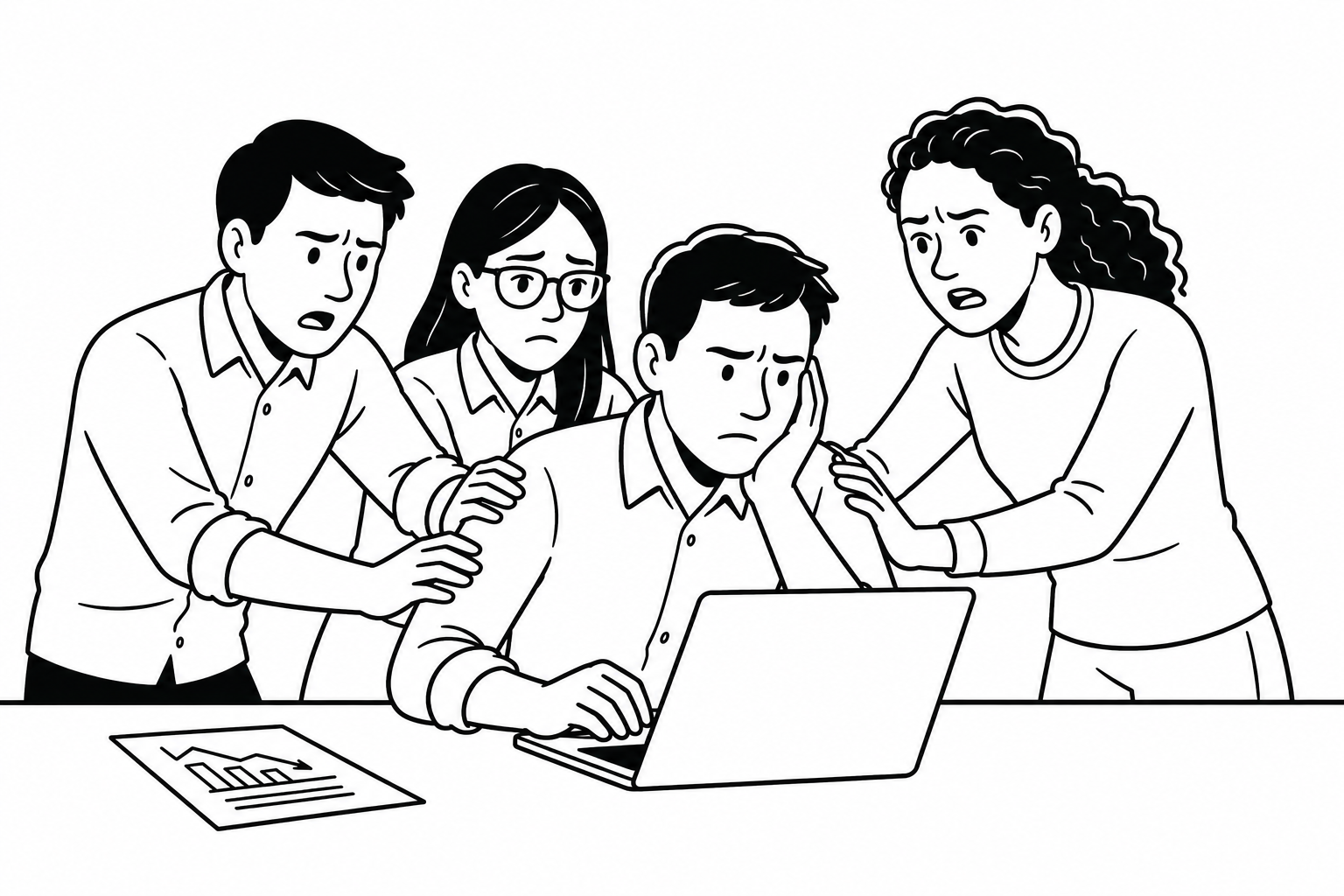


Twenty people. Two countries. A promising startup.
And a team we thought was a winner.
We were scaling up, but hitting targets was harder than it should have been. Top salespeople closed deals, but it was not enough. Lead engineers shipped great features and yet progress was too slow. We thought we had recruited for a high-performing team. We had built a house of cards instead.
Turnover was a constant challenge. Collaboration faced friction. When our top talents left, revenue growth and product development suffered stressful delays. That's when we admitted something needed to change.
The brutal truth: most of what we call high-performing teams aren't so. They can't actually scale.
Here's what the research proves about teams that grow without breaking:
1. Psychological safety (your early warning system)
Team members admit mistakes without fear, knowing their team has their back. People challenge ideas without personal attacks or regrets. The founder regularly says "I don't know" and asks for input [1].
Scaleup results:
2. Clear shared goals (your scaling multiplier)
Every team member can answer: What are we trying to achieve? How does my work contribute? What does success look like? [5]
Scaleup results:
3. Structured collaboration (your operating system)
Structures that enable decentralized decision-making, shared knowledge, and work flowing to teams rather than individual performers [6][8].
Scaleup results:
These three factors, the "Big 3," explain 75% of team effectiveness and create what we call "scalable team intelligence" [2].
Biologist William Muir studied productivity by comparing an average flock of chickens against a "super flock" bred only from the most productive individuals [3].
After six generations, the average flock was doing fine. In the super flock, however, all but three were dead, pecked to death by their peers. The superstar performers had achieved their individual success by suppressing the productivity of others.
Here's what really happens when you over-index on individual performance:
Early stage (10-20 people): The stars get most resources and hit major milestones. Other team members begin to stay quiet and stop contributing ideas. The founder creates dependency, and warning signs appear.
Scaleup stage (20-100 people): Knowledge becomes siloed. Alignment breaks as top decision-makers must decide whether to push, bend, or leave. Cross-functional work breaks down and turnover rises among good talent [7].
Growth stage (100+ people): Decision-making slows to a crawl. Innovation stops as more resources go toward maintaining results. Politics replaces psychological safety [5][8].
We've seen this play out in dozens of scaleups. The companies that break through are the ones that take control early. A team of superstars doesn't guarantee success. In fact, it can easily destroy it.
Based on what worked for us and other scaleups we've worked with:
1. Measure what matters Build your psychological safety indicators. Implement the best feedback system you can. Make this a strategic priority before entering the scale-up stage. Utilize thinking diversity; if you're not, it's working against you [1].
2. Redesign your incentives Reward team outcomes, not individual performance. Publicly recognize people who make others better. Recognize collaboration; don't compare individual outputs [6].
3. Decentralize decision-making Delegate decision-making, not just tasks and responsibilities. Act as a coach rather than telling people what to do. Build your senior management as a team to build performance and keep biases in check [5][7].
4. Avoid the superstar culture Don't hire based solely on CV and past achievements while you're building a new future. Make psychological safety non-negotiable. Fire toxic high performers, even top revenue generators [4][7].
Make growth predictable, not dependent on a few individuals. The companies that scale best aren't the ones with the most superstars. They're the ones with better systems, teamwork, and leadership.
What gave you an edge at the startup stage may no longer serve you at scale-up. You must evolve as a founder and change your operating system.
The founder test:
Most scaleups get only 1 or 2 right. That's why their teams might be hitting targets but slowing down year after year.
If you're moving fast and need a hand, you can always ask for it.
[1] Duhigg, C. (2016). What Google learned from its quest to build the perfect team. The New York Times Magazine. https://www.nytimes.com/2016/02/28/magazine/what-google-learned-from-its-quest-to-build-the-perfect-team.html
[2] Woolley, A. W., Chabris, C. F., Pentland, A., Hashmi, N., & Malone, T. W. (2010). Evidence for a collective intelligence factor in the performance of human groups. Science, 330(6004), 686-688. https://doi.org/10.1126/science.1193147
[3] CIPD. (2023). Team effectiveness: What does the evidence tell us? https://www.cipd.org/uk/knowledge/reports/team-effectiveness-evidence
[4] Delizonna, L. (2017). High-performing teams need psychological safety. Here's how to create it. Harvard Business Review. https://hbr.org/2017/08/high-performing-teams-need-psychological-safety-heres-how-to-create-it
[5] McKinsey & Company. (2023). Decision making in the age of urgency. https://www.mckinsey.com/capabilities/operations/our-insights/decision-making-in-the-age-of-urgency
[6] First Round Review. (2024). The scaling playbook: How the fastest-growing startups build their teams. https://review.firstround.com
[7] InnerEdge. (2024). Founder dependency: The hidden growth killer in scaleups. https://inneredge.fi
[8] MIT Sloan Management Review. (2022). Maintaining agility at scale. https://sloanreview.mit.edu


