
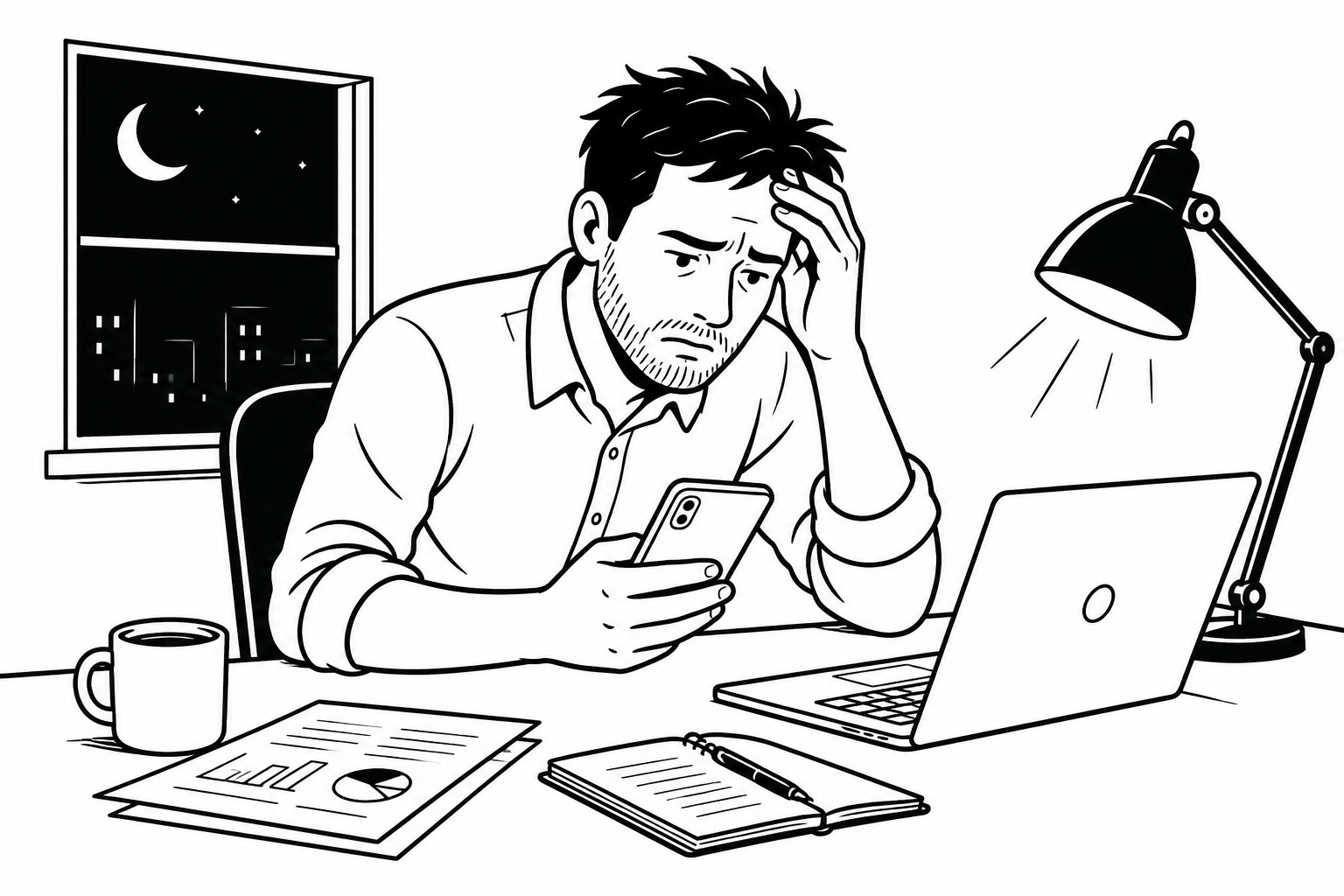


It’s 11 pm on Friday. You’re answering a message your team should have handled. You’ve done it enough times that it’s just how things work now. You're frustrated. With them, with yourself, with the fact that you're here again.
That’s Founder Dependency. And by the time most founders name it, it’s already been slowing them down for months.
Olivier, a founder in France running a business with €2M in annual revenue. When I asked him what would happen if he stepped away for three months, he said, “If I’m not there, everything falls apart. That’s what scares me.”
That’s a signal, not of how important the founder is, but of how fragile the business has become.
Founder Dependency is when decisions run through the founder. Standards are held by them. Momentum depends on them. The business slows down because no system has been set up to work without the founder in the room. Founders are the system.
It shows up in recognisable ways:
Look at the four signs again. Decisions and escalations sit in Leadership. Being involved in too many areas sits in Effectiveness. Having no real time off sits in Wellbeing. These are the three pillars of how a founder operates, and in a scaleup, all three need to move from you into the organisation.
Founder Dependency doesn't appear overnight. It's built, brick by brick, by the founders themselves, usually with the best intentions. What was a strength at the startup stage becomes a weakness at the scaleup phase.
In the early days, being close to everything made sense. Speed mattered. But what works at €500K no longer works the same after €1M. The habits that built the business start holding it back.
Are these rationalisations familiar?
"It's faster if I do it myself."
"They won't do it the way I want."
"Once we close the next round, I'll fix it."
These are the result of pressures. They can also become the reason nothing changes.
Underneath those rationalisations, there's usually something deeper: identity, control, ego, fear. "Who am I if I'm not the one driving this?" "If I let go, things will fall apart." “How would people see me if I don’t do it?”
You may believe these are business problems. They’re leadership problems and precisely why they're hard to solve with a better project management tool.
As Kris, a UK founder with €2M in annual revenue, put it: "At one point, I was too operational and still trying to do the strategy stuff. It's impossible to do."
Exactly.
You can't be in the details of operations and see the bigger picture at the same time. Usually, thinking and critical improvement are sacrificed. Without them, we get stuck.
Reducing Founder Dependency means changing what you do and how you show up. That work sits in three pillars: Leadership, Wellbeing and Effectiveness. Within them are five shifts that, applied together, move ownership from the founder into the organisation.
How you decide and see clearly.
The goal is to hire people to build teams, so they lead and tell you what to do, not the other way around. When your team keeps escalating decisions, the system rewards asking over deciding. Coaching your team to make decisions, rather than providing answers, is one of the fastest ways to shift that dynamic.
The founder is often the last person in the room to see their own blind spots. That's nature, and it says nothing about your ability. You're too close. Structured feedback, whether from your team or from someone outside the business entirely, creates the kind of visibility that no dashboard can give you. A coach's job, for example, is to get you new perspectives so you can decide and perform better.
The capacity you bring to the job.
Plans fail. Markets shift. People leave. Founders who are consumed by the business have little capacity to absorb any of that. Resilience is a practice. Treat yourself like a professional athlete: recovery, perspective, and emotional regulation are part of the performance.
Where your time and your role go.
When the day-to-day owns your calendar, strategy gets squeezed out because everything feels urgent. This shift protects the time and headspace you need.
Your role must evolve as the business grows. What you do every day needs to change with it. Many founders are still doing a job that made sense at an earlier stage and now costs them. Defining what your job actually is at this stage of the business matters more than it sounds.
The founder is often the last person in the room to see their own blind spots. That's not a criticism, it's nature. You're too close. Structured feedback, whether from your team or from someone outside the business entirely, creates the kind of visibility that no dashboard can give you. A coach’s job, for example, is to get you new perspectives so you can decide and perform better.
Founder Dependency is a sign that the founder built something that worked; it’s not failure. The problem is that what worked then is limiting what's possible now.
The shift starts with identity: being intentional about letting go. That's harder than it sounds when the business has been an extension of you for years. But it's the prerequisite for everything else. You need to build a new operating system that was not critical before.
The three pillars move together. Stronger Leadership frees up your calendar. A clearer calendar gives you room to recover. Recovered, you’re more efficient. Apply the five shifts across all three, and you build a business that keeps moving in the right direction. Build the system that supports you in running and growing your business. That's scaling up.
Take the Founder Dependency Score: a short diagnostic that shows you where you are and what to focus on first. It takes five minutes, and it’s direct: https://tally.so/r/RGLvEQ


